

Plastic tensile modulus and Poisson's ratio test
Abstract Summary: This article introduces the use of the Kunpeng BOYI 2025 electronic universal material testing machine, combined with a manual wedge tensile fixture, Reliant precision axial extensometer, and transverse extensometer. According to "GB/T 1040.1-2018 Determination of Tensile Properties of Plastics" and "GB/T 1040.2-2022 Determination of Tensile Properties of Plastics Part 2: Test Conditions for Molded and Extruded Plastics," an example test of plastic tensile modulus and Poisson's ratio was conducted. The test results show that the Kunpeng BOYI 2025 electronic universal material testing machine can fully meet the requirements of plastic tensile testing.
Keywords: Kunpeng BOYI 2025 electronic universal material testing machine Plastic Polymer Polymer Tensile test Tensile modulus Poisson's ratio
Plastic raw materials Defined as a material made from synthetic or natural high molecular polymer , which can be molded into various shapes and retain the shape without deformation, or plastic products. Plastics are important organic synthetic polymer materials. Due to their excellent physical and chemical properties and processing characteristics, they are widely used in daily work and life. According to different usage characteristics, plastics are generally divided into general-purpose plastics , engineering plastics, and specialty plastics three types. This application selected the 5 most common plastics in daily life for testing, allowing a direct comparison of the mechanical property differences among various plastics. The electronic universal material testing machine is one of the most important physical performance testing devices for analyzing the mechanical properties of plastics. The Kunpeng testing machine is equipped with a manual wedge tensile fixture, which can quickly clamp specimens without the aid of tools. It is also equipped with a sample centering device to ensure consistent specimen placement each time, greatly improving testing efficiency and reproducibility. The wedge clamping method used by the fixture applies less pre-stress than traditional flat clamping fixtures and provides stable clamping force throughout the tensile process. Besides the fixture, this test uses Reliant precision axial and transverse extensometers combined with the high precision and over 1000Hz acquisition frequency of the testing machine mainframe to fully record all characteristic data during the tensile process, providing users with accurate and reliable test data. Coupled with intelligent testing software, it can simultaneously provide various test curves such as single specimen, multiple specimens, and dual coordinates, offering a good interactive experience for different users and supporting enterprise R&D, quality, and product control.
1. Test Section 1.1 Instruments and Fixtures BOYI 2025-010
Electronic universal testing machine
10kN manual wedge tensile fixture
Reliant axial extensometer Reliant transverse extensometer
Smartest software
1.2 Analysis Conditions
Test temperature: room temperature around 22°C
Load sensor: 10kN (class 0.5)
Loading test speed: 5mm/min
Fixture spacing: 115mm
Gauge length: 50mm
1.3 Samples and Treatment
In this test, 5 types of injection-molded plastic specimens were selected, including raw materials or reinforced plastics, with materials being PP, PP+EPDM+TD20, ABS, PC, PA6+30GF. All specimens are type 1A according to GB/T 1040.2, with 5 specimens each.
2. Test Introduction
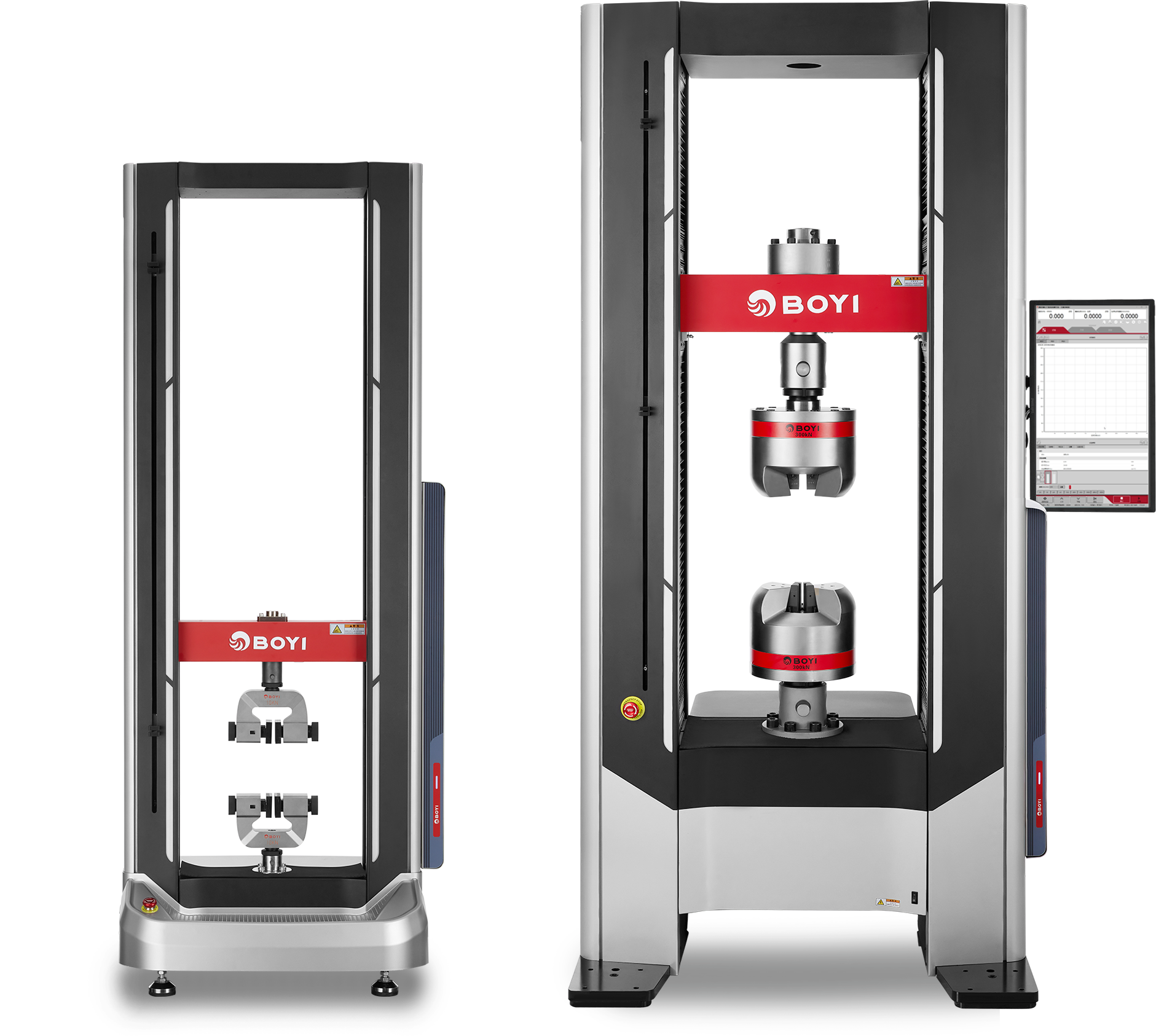
 Using the BOYI 2025-010 electronic universal testing machine, the specimens were clamped between the upper and lower fixtures. Specimen protection was enabled, and the pre-stress after clamping was eliminated. Then, the transverse and axial extensometers were clamped at the middle part of the specimen, zeroed, and the test was conducted at a speed of 5mm/min until the tensile strain exceeded the range for tensile modulus and Poisson's ratio measurement, after which the test was stopped and the extensometers removed. Force and deformation data were measured during the process, and tensile test curves were generated.
Figure 7


Test system diagram (mainframe, fixture, extensometers)
3. Results and Conclusions

3.1 Test Results The specific test results are shown in Table 1.
Table 1. Test Results
Figure 8 - Test curve PP
Figure 9 - Test curve PP+EPDM+TD20
Figure 10 - Test curve ABS

 Figure 11 - Test curve PC
 Figure 12 - Test curve PA6+30GF
 From the above (Table 1) data and test curves, it can be seen that the tensile curves are smooth and continuous, with no abnormal phenomena such as loosening or slipping. The software can record the complete test curve throughout the process and obtain data such as load, displacement, axial deformation, and transverse deformation for analysis. Differences in curves among various samples due to different materials are evident. Samples with higher modulus and rigidity have steeper curve slopes. Each group of 5 specimens shows good reproducibility, meeting standard requirements. The test results demonstrate that the Kunpeng BOYI 2025-010
 图11-试验曲线PC
 图12-试验曲线PA6+30GF
从上(表1)数据以及试验曲线可以看出,拉伸曲线平滑连续,无松动打滑等异常现象,软件可以记录整个过程中完整的试验曲线,可以获取载荷、位移、轴向变形、横向变形等各项数据用于分析。可以看出各种样品之间因材质不同的曲线差异,模量大刚性高的样品,曲线斜率更大,每组各5个试样重现性良好,满足标准要求。从本次试验结果可以体现出鲲鹏BOYI 2025-010 The high precision and high stability of the electronic universal testing machine.
4. Conclusion
The above test results indicate that the Kunpeng BOYI 2025-010 The electronic universal testing machine, combined with a manual wedge tensile fixture, Reliant axial extensometer, and transverse extensometer, can fully meet the requirements of the standards "GB/T 1040.1-2018 Plastics - Determination of tensile properties" and "GB/T 1040.2-2022 Plastics - Determination of tensile properties Part 2: Test conditions for moulding and extrusion plastics," efficiently and with high quality. Through a high-precision, high-sampling-rate testing system, various mechanical data of plastic materials can be obtained reliably and stably. This is very important for the technological development of plastic materials and can provide data support and technical assurance for enterprises' product research and development, quality management, as well as standardization and normalization in the industry.
National Service Hotline
Company Headquarters: Room 102, Building 4, Autelang Technology Park, No. 68 Nanxiang 1st Road, Huangpu District, Guangzhou, Guangdong Province
Manufacturing Center: No. 299 Maofeng Road, Xukou Town, Wuzhong District, Suzhou City, Rizhongtian Industrial Park


SAF Coolest v1.2 设置面板 REGSX-ZFTZ-IVSSE-ZQD
无数据提示
Sorry, there is no content in this section currently!
You can view other sections or return Home
SVG图标库请自行添加图标,用div包起来,并命名使用
Welcome to the Testing Machine Configuration Assistance System!
Thank you for using this system.
Just answer a few questions about the test to create a test system suitable for you.
If you have multiple answers to a question, please choose the most important one.
If you have any matters to confirm, please click this button to contact us.
CONTACT US