

Rubber and Fabric Adhesion Strength Test
Abstract Summary: This article introduces the use of the Kunpeng BOYI 2025 electronic universal material testing machine, combined with a pneumatic double push-pull tensile fixture, to measure the bonding strength between rubber and fabric according to the "GB/T 532-2008 Determination of Bonding Strength between Vulcanized Rubber or Thermoplastic Rubber and Fabric". The test results show that the Kunpeng BOYI 2025 electronic universal material testing machine can fully meet the requirements for testing the bonding strength between rubber and fabric.
Keywords: Kunpeng BOYI 2025 Electronic Universal Material Testing Machine Vulcanized Rubber Thermoplastic Rubber Bonding Strength Test
Rubber, due to its excellent elasticity, is widely used in daily work and life. By combining it with fibers, the strength, dimensional stability, fatigue resistance, wear resistance, and service life of rubber can be greatly improved. This allows rubber-fabric composite products to be used under broader and more demanding conditions. There are three main methods for rubber-fabric composite bonding: dipping, coating, and direct bonding. This application mainly focuses on products using the direct bonding method.
The Kunpeng testing machine is equipped with a pneumatic double push-pull tensile fixture that can continuously provide a constant clamping force during the peeling process, preventing slippage or detachment. Additionally, with the foot switch, it enables quick positioning and clamping before testing and quick return and replacement after testing, improving operational convenience and testing efficiency, greatly saving test time. Besides the fixture, the high precision of the testing machine's main unit and a data acquisition frequency exceeding 1000Hz can fully record all characteristic data during the peeling process, providing users with accurate and reliable test data. Coupled with intelligent testing software, it can simultaneously provide various test curves such as single sample, multiple samples, and dual coordinates, offering a good interactive experience for different users and supporting enterprises in research and development, quality, and product control.
 1. Test Section
1.1 Instruments and Fixtures
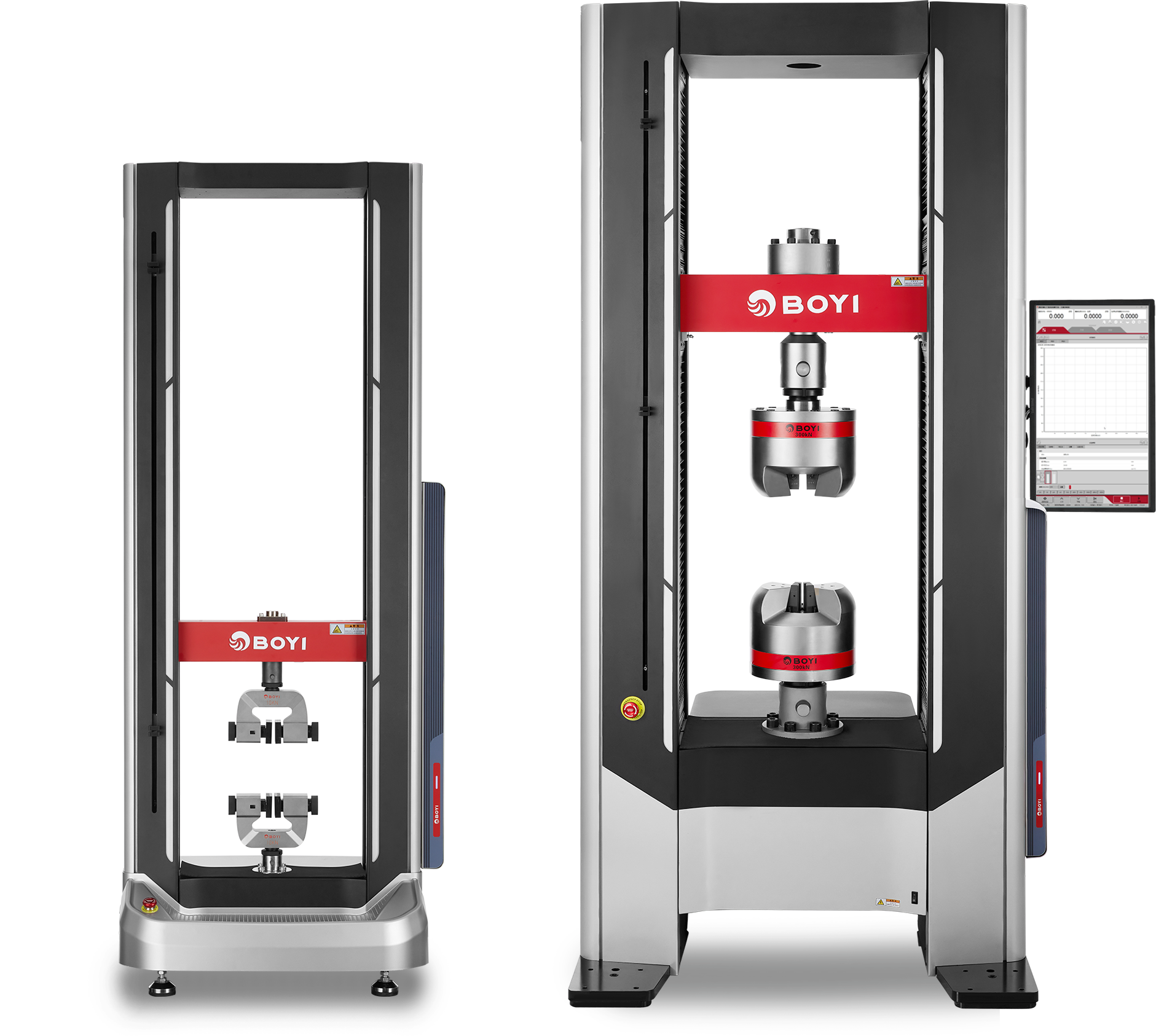
BOYI 2025-001 Electronic Universal Testing Machine
500N Pneumatic Double Push-Pull Tensile Fixture
Smartest Software
1.2 Test Conditions
Test Temperature: Room temperature around 22°C
Load Sensor: 1kN (Class 0.5)
Loading Test Speed: 50mm/min
1.3 Samples and Treatment
In this test, rubber and fabric bonding samples with a width of 25mm were selected, with 3 samples each.

Figure 1 - Test Samples
2. Test Introduction
The test was conducted using the BOYI 2025-001 electronic universal testing machine. The samples were clamped in the upper and lower fixtures and tested at a speed of 50mm/min, peeling over a distance exceeding 100mm. Force and displacement data were measured during the process, and peeling curves were generated.

Figure 2 Test System Diagram (Main Unit, Fixture)
3. Results and Conclusions
3.1 Test Results
The specific test results are shown in Table 1 below.
Table 1. Test Results

 Figure 3 - Test Curve
 Figure 4 - Test Curve 3
 Figure 5 - Enlarged Curve 3
From the data in Table 1 and the test curves above, it can be seen that after the test starts, the sample peels continuously and steadily. The load fluctuates up and down with displacement, with peak and valley values clearly distinguishable. The software can record the complete test curve throughout the process, allowing acquisition of average peeling force, peak, valley, and other data for analysis. The test results demonstrate the high precision and stability of the Kunpeng BOYI 2025-001 electronic universal testing machine.
4. Conclusion
The above test results indicate that the Kunpeng BOYI 2025-001 electronic universal testing machine and pneumatic double push-pull tensile fixture fully meet the requirements of the "GB/T 532-2008 Determination of Bonding Strength between Vulcanized Rubber or Thermoplastic Rubber and Fabric" standard, efficiently and effectively completing the test. Through a high-precision, high-sampling-rate testing system, various mechanical data of rubber-fabric composites can be obtained reliably and stably. This is very important for the technological development of rubber-fabric composites and can provide data support and technical assurance for enterprises' product research and development, quality management, and the standardization and regulation of the industry.
National Service Hotline
Company Headquarters: Room 102, Building 4, Autelang Technology Park, No. 68 Nanxiang 1st Road, Huangpu District, Guangzhou, Guangdong Province
Manufacturing Center: No. 299 Maofeng Road, Xukou Town, Wuzhong District, Suzhou City, Rizhongtian Industrial Park


SAF Coolest v1.2 设置面板 REGSX-ZFTZ-IVSSE-ZQD
无数据提示
Sorry, there is no content in this section currently!
You can view other sections or return Home
SVG图标库请自行添加图标,用div包起来,并命名使用
Welcome to the Testing Machine Configuration Assistance System!
Thank you for using this system.
Just answer a few questions about the test to create a test system suitable for you.
If you have multiple answers to a question, please choose the most important one.
If you have any matters to confirm, please click this button to contact us.
CONTACT US