

Tape 90° and 180° Peel Test
Abstract Summary This article introduces the use of the Kunpeng BOYI 2025 electronic universal material testing machine, combined with a 100N load sensor, a 50N manual flat tensile fixture, and a 90° peel test fixture. According to Method 1 and Appendix B of the "GB/T 2792-2014 Test Method for Adhesive Tape Peel Strength," examples of 90° and 180° peel tests on adhesive tape were conducted. The test results show that the Kunpeng BOYI 2025 electronic universal material testing machine can fully meet the requirements for adhesive tape peel strength testing.
Keywords Kunpeng BOYI 2025 electronic universal material testing machine Adhesive tape Peel test
Adhesive tape is composed of a substrate and an adhesive two parts. It connects two or more unconnected objects through adhesion. Its surface is coated with an adhesive, which forms bonds through intermolecular forces with the surface of the adhered object. These bonds can firmly hold the molecules together. Depending on different substrates, adhesives, and adhesion forms, adhesive tapes can have various variations. According to the substrate, they can be divided into BOPP tape, cloth-based tape, 、 kraft paper tape, 、 masking tape, 、 fiber tape, 、 PVC tape, PE foam tape, etc. According to adhesion type, they are divided into single-sided and double-sided tapes. With economic development and technological progress, China has become a major processing, production, and consumption country in the global adhesive industry, growing at an annual rate of 16%. Especially adhesive tapes, protective films, and stickers are widely used in electronics, communications, packaging, construction, papermaking, woodworking, aerospace, automotive, textiles, metallurgy, machinery manufacturing, and medical industries. The adhesive industry has become one of the most dynamic and important sectors in China's chemical industry. Peel strength, as the most important indicator of tape performance, can be accurately tested and characterized using the Kunpeng electronic universal testing machine. This test uses the most common single-sided pressure-sensitive tape as the test sample.
The Kunpeng testing machine is equipped with a 100N load sensor capable of measuring forces above 0.2N, ensuring the accuracy of mechanical performance test data for adhesive tapes. The 50N manual flat tensile fixture used is lightweight (about 5N), allowing clamping of samples without affecting the sensor's measurement range, ensuring that the fixture's own weight does not affect test accuracy. Meanwhile, the 90° peel fixture used features a high-precision slide rail and synchronization device, keeping the sample substrate and the testing machine axis at a constant 90° angle, ensuring the test process meets the requirements of Appendix B of the standard. The testing machine's main unit has high precision and a data acquisition frequency exceeding 1000Hz, which can fully record all characteristic data during the peel process, providing users with accurate and reliable test data. Coupled with intelligent testing software, it can simultaneously provide various test curves such as single sample, multiple samples, and dual coordinates, offering a good interactive experience for different users and supporting enterprises in research and development, quality, and product control. 1. Test Section
1.1 Instruments and Fixtures
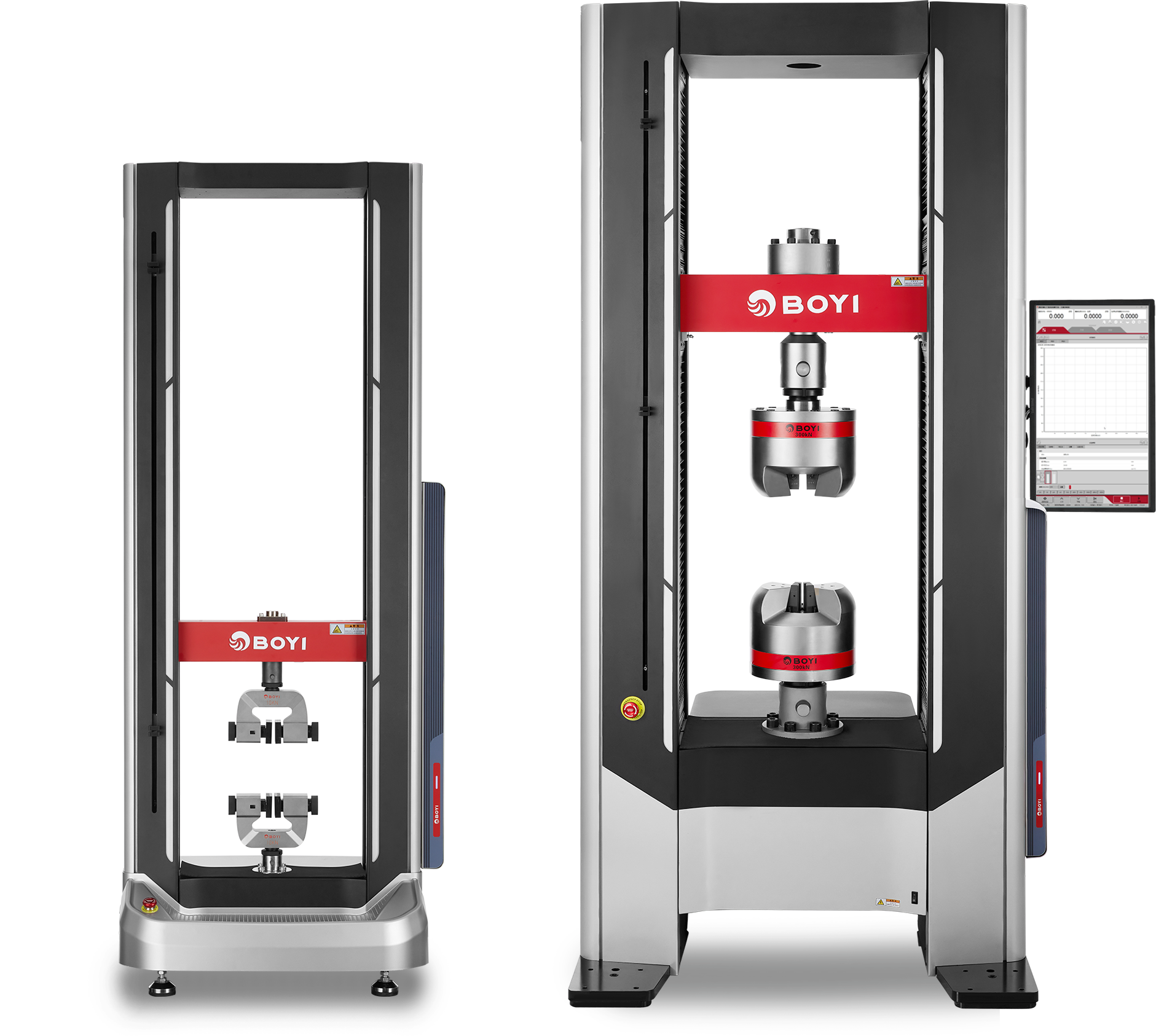
BOYI 2025-001
Electronic Universal Testing Machine 50N Manual Flat Tensile Fixture
90° Peel Fixture
Smartest Software
1.2 Test Conditions
Test temperature: Room temperature around 22°C
Load sensor: 100N (Class 0.5)
Test loading speed: 300mm/min
1.3 Samples and Treatment
 In this test, single-sided pressure-sensitive tape with a width of 19.0mm was selected. Using a 2N standard rubber roller, the tape was adhered to a standard steel plate with a surface roughness of 50±25nm. The samples must be free of bubbles after adhesion to avoid abnormal results. Three samples were prepared, and testing was conducted within 5 minutes after adhesion.
2. Test Introduction

Using the BOYI 2025-001 electronic universal testing machine, the sample was clamped between upper and lower fixtures and tested at a speed of 300mm/min until the peel distance exceeded 50mm. After reaching the set distance, the device automatically stopped and returned. The device fully recorded force and deformation data during the measurement process and generated peel test curves. The average peel force from 25mm to 50mm on the peel curve was divided by the sample width, and the result expressed in N/cm represented the peel strength of the sample.
Figure 5

Test system diagram (90° peel test main unit and fixtures) Figure 6 Standard 90° peel fixture schematic Figure 7
 180° peel test main unit and fixtures)

3. Results and Conclusions Figure 6 Standard 90° peel fixture schematic 3.1 Test Results
The specific test results are shown in Table 1.
Table 1. Test Results
Figure
8 - Test Curve - 90° Peel

 9 - Curve - 180° Peel 8-试验曲线-90°剥离
 9 - Curve - 180° Peel 9-曲线-180°剥离
From the data in Table 1 and the test curves, it can be seen that the peeling curve is smooth and continuous, with no abnormal fluctuations. After the initial peak value of peeling appears, the software immediately drops and enters a continuous and stable peeling process until the end of the test. The software records the complete test curve throughout the process, allowing for the acquisition of load, displacement, and other data for analysis. Thanks to the high precision of the 100N sensor, the force value can be displayed and recorded at the mN level, with curve fluctuations within 0.2N. The peeling strength of samples made using standard steel plates and standard rollers is very close, avoiding abnormal results caused by differences in sample preparation methods. Combined with stable fixtures, it fully meets the standard testing requirements. The test results reflect the high precision and high stability of the Kunpeng BOYI 2025-001 electronic universal testing machine.
4. Conclusion
The above test results indicate that the Kunpeng BOYI 2025-001 electronic universal testing machine, equipped with a 100N load sensor, 50N manual flat tensile fixture, and 90° peeling fixture, can fully meet the requirements of Method 1 and Appendix B of the "GB/T 2792-2014 Test Method for Peeling Strength of Adhesive Tape" standard, efficiently and effectively completing the test. Through a high-precision, high-sampling-rate testing system, various mechanical data of plastic materials can be obtained reliably and stably. This is very important for the technological development of adhesive tape materials, providing data support and technical assurance for enterprises' product research and development, quality management, as well as standardization and regulation in the industry.
National Service Hotline
Company Headquarters: Room 102, Building 4, Autelang Technology Park, No. 68 Nanxiang 1st Road, Huangpu District, Guangzhou, Guangdong Province
Manufacturing Center: No. 299 Maofeng Road, Xukou Town, Wuzhong District, Suzhou City, Rizhongtian Industrial Park


SAF Coolest v1.2 设置面板 REGSX-ZFTZ-IVSSE-ZQD
无数据提示
Sorry, there is no content in this section currently!
You can view other sections or return Home
SVG图标库请自行添加图标,用div包起来,并命名使用
Welcome to the Testing Machine Configuration Assistance System!
Thank you for using this system.
Just answer a few questions about the test to create a test system suitable for you.
If you have multiple answers to a question, please choose the most important one.
If you have any matters to confirm, please click this button to contact us.
CONTACT US