

Test of tensile modulus and Poisson's ratio of laminated board
Abstract: This article introduces the use of the Kunpeng BOYI 2025 electronic universal testing machine, combined with a manual wedge tensile fixture, Reliant precision axial extensometer, and transverse extensometer, referencing ASTM D638-22 Standard Test Method for Tensile Properties of Plastics , to conduct tensile modulus and Poisson's ratio tests on laminated boards. The test results show that the Kunpeng BOYI 2025 electronic universal testing machine can fully accommodate tensile testing of laminated boards.
Keywords: Kunpeng BOYI 2025 electronic universal testing machine, laminated board, PCB substrate, tensile test, tensile modulus, Poisson's ratio
Laminated boards are a type of laminate product. Laminate products are integrally formed by bonding two or more layers of resin-impregnated fibers or fabrics through stacking and hot pressing. Laminate products can be processed into various insulating and structural components, widely used in motors, transformers, high and low voltage electrical appliances, electrical instruments, and electronic equipment. With the development of the electrical industry, high insulation, high-strength, heat-resistant, and adaptable laminated plastic products have successively emerged. Copper-clad laminated boards for printed circuits have also rapidly developed due to the needs of the electronics industry. The performance of laminate products depends on the substrate, adhesive, and molding process. According to their composition, characteristics, and heat resistance, laminate products can be divided into organic substrate laminates and inorganic substrate laminates. This application selects the commonly used PCB substrate in the circuit board industry—epoxy glass fiber laminate—as the sample for testing. Various mechanical tests on laminated boards can be performed using the universal testing machine to characterize their mechanical properties, thereby ensuring quality control of laminated boards. The Kunpeng testing machine is equipped with a manual wedge tensile fixture that allows rapid clamping of specimens without tools. It also includes a sample holding device to ensure consistent specimen placement each time, greatly improving testing efficiency and reproducibility. The wedge clamping method used by the fixture applies less prestress than traditional flat clamping fixtures and provides stable clamping force throughout the tensile process. Besides the fixture, this test uses Reliant precision axial and transverse extensometers combined with the high precision and over 1000Hz acquisition frequency of the testing machine's main unit to fully record all characteristic data during the tensile process, providing users with accurate and reliable test data. Coupled with intelligent testing software, it can simultaneously provide various test curves such as single specimen, multiple specimens, and dual coordinates, offering a good interactive experience for different users and supporting enterprises in R&D, quality, and product control.
1. Test Section
 1.1 Instruments and Fixtures
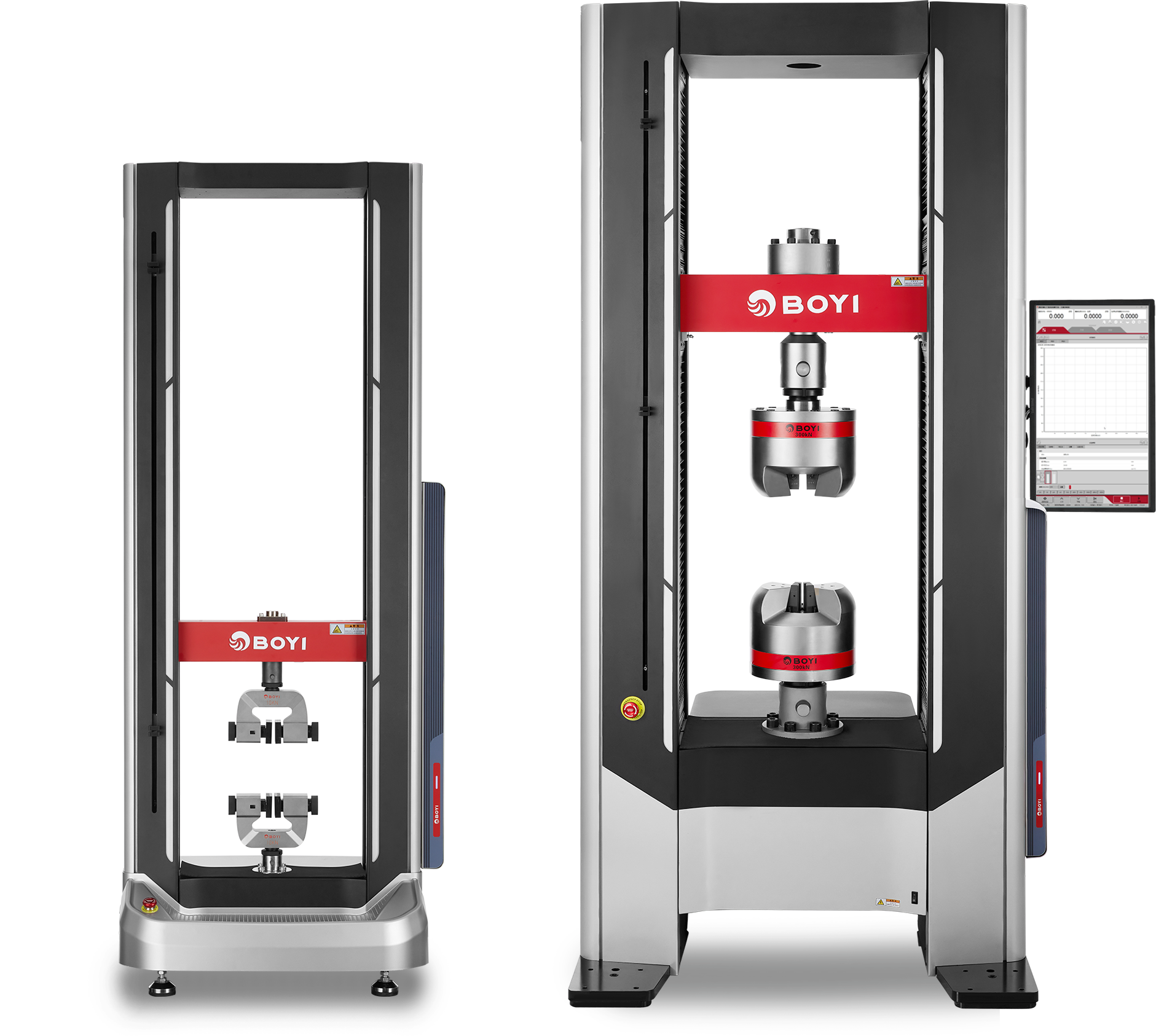
BOYI 2025-010 Electronic Universal Testing Machine
10kN Manual Wedge Tensile Fixture
Reliant Axial Extensometer
Reliant Transverse Extensometer
Smartest Software
1.2 Analysis Conditions
Test temperature: approximately 22°C room temperature
Load sensor: 10kN (0.5 grade)
Loading test rate: 5 mm/min
Fixture spacing: 115 mm
Gauge length: 50 mm
1.3 Samples and Treatment
In this test, laminated boards with a length of 165 mm and a middle parallel section width of about 10 mm were selected, with a quantity of 3.
Figure 1 Standard Specimen

2. Test Introduction
Using the BOYI 2025-010 electronic universal testing machine, the sample is clamped between the upper and lower fixtures. After enabling the load zero-hold function, the clamping force generated by the fixture is automatically eliminated. Then, the transverse and axial extensometers are clamped at the middle part of the specimen, both zeroed, and the test is conducted at a speed of 5 mm/min until the tensile strain exceeds the range for tensile modulus and Poisson's ratio measurement. The extensometers are then removed, and the test continues until the specimen breaks. Force and deformation data are measured during the process, and tensile test curves are generated.
Figure 2 Test System Diagram (Main Unit, Fixture, Extensometers)

3. Results and Conclusions
3.1 Test Results
The specific test results are shown in Table 1 below.
Table 1. Test Results
Figure 3 - Test Curves

 From the data in Table 1 and the test curves above, it can be seen that the tensile curve is smooth and continuous, with no abnormal phenomena such as loosening or slipping. The software can record the complete test curve throughout the process and obtain data such as load, displacement, axial deformation, and transverse deformation for analysis. The data reproducibility is good and meets standard requirements. The test results demonstrate the high precision and stability of the Kunpeng BOYI 2025-010 electronic universal testing machine.
4. Conclusion
The above test results indicate that the Kunpeng BOYI 2025-010 electronic universal testing machine, combined with the manual wedge tensile fixture, Reliant axial extensometer, and transverse extensometer, fully meets the requirements of ASTM D638-22 standard and efficiently completes the test with high quality. Through the high-precision, high-sampling-rate testing system, various mechanical data of laminated boards can be obtained reliably and stably. This is very important for the technological development of plastic materials and can provide data support and technical assurance for enterprises' product R&D, quality management, and the standardization and normalization of the industry.
上述试验结果表明,鲲鹏BOYI 2025-010 电子万能试验机配合手动楔形拉伸夹具、Reliant轴向引伸计以及横向引伸计,可以完全满足《ASTM D638-22 Standard Test Method for Tensile Properties of Plastics 》标准要求,高效高质完成试验。通过高精度高采样率的测试系统,可以获得层压板的各项力学数据,且稳定可靠,这对于塑料材料的技术发展非常重要,能够为企业的产品研发、品质管理,以及该行业的标准化、规范化提供数据支持与技术保障。
National Service Hotline
Company Headquarters: Room 102, Building 4, Autelang Technology Park, No. 68 Nanxiang 1st Road, Huangpu District, Guangzhou, Guangdong Province
Manufacturing Center: No. 299 Maofeng Road, Xukou Town, Wuzhong District, Suzhou City, Rizhongtian Industrial Park


SAF Coolest v1.2 设置面板 REGSX-ZFTZ-IVSSE-ZQD
无数据提示
Sorry, there is no content in this section currently!
You can view other sections or return Home
SVG图标库请自行添加图标,用div包起来,并命名使用
Welcome to the Testing Machine Configuration Assistance System!
Thank you for using this system.
Just answer a few questions about the test to create a test system suitable for you.
If you have multiple answers to a question, please choose the most important one.
If you have any matters to confirm, please click this button to contact us.
CONTACT US